


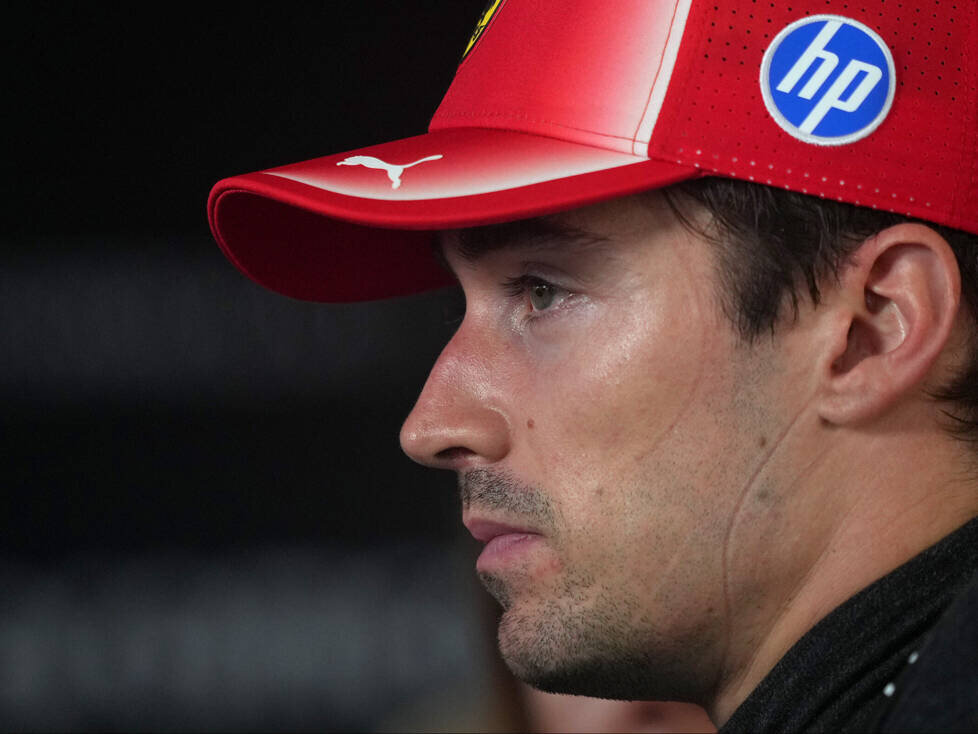
Charles Leclerc explains why Ferrari opted for slicks in Malaysia and why, of all things, the water on the track ruined the decision
Following the Bahrain Grand Prix in Malaysia, Charles Leclerc openly admitted that Ferrari’s decision to start on slicks was ultimately based on intuition. In damp conditions, Ferrari sent both cars into the race on dry tyres – a decision that proved to be a mistake.
Leclerc explains why the teams had hardly any reliable data to base their tyre choice on. “It was based on intuition, on looking at the track surface. The surface looked pretty dry,” said Leclerc. The real problem, however, was how much water was in the grooves of the tarmac.
“The biggest unknown was how much water was in the grooves of the tarmac. And there was significantly more water than most people had probably thought. That’s why the slicks turned out to be the wrong decision in the end.”
Ferrari: There was hardly any data
“It’s very difficult. It was the same for everyone,” says the Ferrari driver. Although Ferrari did have a little data to go on, it had been collected under conditions that were hardly comparable to those of the race.
For Leclerc, therefore, the tyre choice was a real risk. With split strategies, there is inevitably one side that performs significantly better and one that performs significantly worse. “When you split the cars, by definition there’s one very wrong decision and one very good one. It’s very difficult to have a scenario in between where both options work roughly equally well.”
Ferrari therefore believed they were making the right decision by putting both cars on slicks. At the same time, Leclerc points to Red Bull, who, in his view, manage particularly often to put both cars on the right strategy in such situations without splitting their approach.
Leclerc fights his way back
Despite Leclerc’s mistake at the start and a collision on the first lap, Ferrari still managed to finish the race with both cars in the top four. Leclerc came fourth, whilst his team-mate Lewis Hamilton took third place.
“In the first half of the race, everything that could go wrong did go wrong. In the second half, everything that could have gone right for us did,” explained Leclerc. For him, the two extremes ultimately balanced each other out.
“I think that with a normal race, we would have finished third and fourth,” said the Monegasque driver. Kimi Antonelli and Max Verstappen were simply too fast on the day. Luck and bad luck ultimately balanced each other out.
Leclerc laments pace: Things were still looking good on Friday
However, Leclerc wasn’t just struggling with the tyres. Following the collision on lap one, Ferrari had to replace the front wing and the damaged nose on his car, which cost additional time. Nevertheless, he managed to fight his way back into the leading group.
Ferrari team principal Fred Vasseur therefore described the result as strong, despite the wrong tyre choice. “50 per cent of the cars were on slicks, 50 per cent on intermediates,” explains Vasseur. From the pit wall, it hadn’t been easy to get a complete picture of the track.
“But we were certainly on the wrong side,” the Ferrari team principal admitted. Following Leclerc’s collision on the first lap and the necessary nose change, returning to third and fourth places was a strong result for the team.
Leclerc himself is already looking into the causes of his own problems following the difficult race. “For me, it was just very difficult with the car, and we’ll look into that,” he says. On Friday, he’d still had a good feeling, which had initially held up until qualifying. In the third qualifying session, he then began to lose ground.