


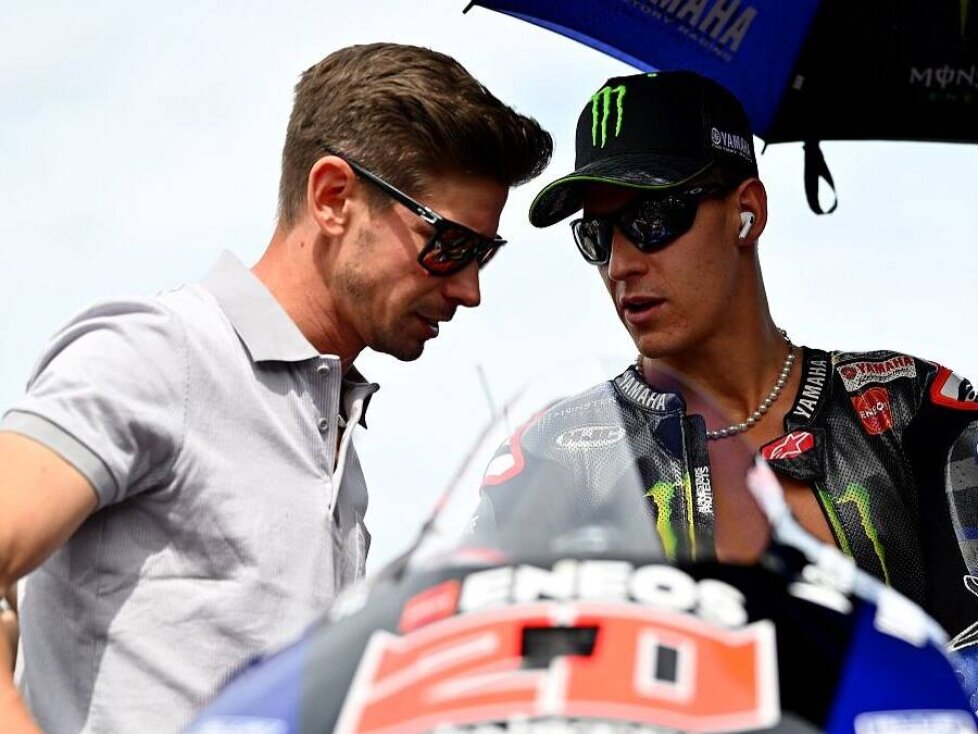
Casey Stoner speaks plainly about MotoGP and accuses the series of robbing riders of their skills—the former rider calls for less electronics and more racing
During one of his visits to a race this season, former MotoGP rider Casey Stoner was unusually open in his criticism of the current premier class. For the Australian, MotoGP is “no longer what it used to be,” and one of the reasons why he could never imagine returning.
He believes that today’s motorcycles are neither appealing nor challenging to ride. This is partly due to the electronics. “Always a very difficult, sensitive topic,” says Stoner. Riders have one idea, engineers and manufacturers often have a completely different one. But because MotoGP prototypes do not become road bikes, he believes there is no reason to develop the systems “as far as they have now been developed.” This season in particular has seen the addition of “a whole new level of electronics” – the extended stability control that was introduced at Spielberg. In conversation with current riders, he learned that today, “with almost 300 hp, you can just twist the throttle” without anything happening. For Stoner, it’s therefore clear: “We have the best riders in the world on the easiest bikes to ride in the world, and that’s just not appealing to me.”
The machines take away all decision-making options from the riders. Even in his own final tests before his definitive retirement, he was no longer allowed to use the clutch to brake “because it confused the system.”
Simple processes thanks to complex systems
Instead of complex riding techniques, it’s now all about a simple pattern: “Brake hard, throw yourself into the corner, then open the throttle and press a button to lower the bike.”
At the same time, Stoner criticizes the consequences of electronic interventions. “We have problems with tire temperature. We have problems with stability. We’ve seen worse accidents than ever before in MotoGP, and yet these bikes are somehow safer. I don’t see it that way,” says Stoner. Because when you leave all control of the rear to the electronics, you lose all fear and increasingly seek the limit on the front wheel. For him, that’s the opposite of safe: “We’ve seen catastrophic accidents when you lose the front of the bike and it comes back. So the safer you make the rear, the worse it gets at the front end—with the corresponding consequences.”
Growing risks instead of greater safety
Stoner also sees aerodynamics and speed as a problem. The margin for error when braking is “tiny.” Every rider is pushing the absolute limit, which is why you see so many bikes “at the end of the straight in the barriers.”
“So there has to be a point where we stop adding all these things, where we stop making it easier to exit corners, because anti-wheelie systems don’t solve a safety problem. It’s a convenience.”
At the same time, Stoner calls for the rear to be left more to the rider again – with a certain amount of external control, but without permanent intervention. Electronics should only be used “where they really provide a safety net.” Otherwise, we will end up in a situation where “we are turning engineers into champions, not riders.”
Stoner’s assessment of the 2027 regulations
Stoner also reacts with clear rejection to the rule changes for 2027. When asked whether they go far enough, he says: “Not even close.”
“They’re making the bike lighter, which shifts the braking point further back. The top speed will be lower because there is no longer a ride height device. That means a lighter bike will go into the corner, the braking points will be shorter, and there will be fewer overtaking opportunities.”
Winglets will still be allowed. However, the Australian predicts that turbulent air on lighter bikes will cause “further stability and tire problems.” He doesn’t understand how no one can see “that every step makes the problem worse.”
“Created problems that didn’t exist before”
There are numerous examples of such things not working. For example, it took Formula 1 years to correct precisely such mistakes. “In my opinion, they have done a very good job of creating races and an incredible championship,” he enthuses. Today, it delivers more spectacular racing than motorcycles: “These cars are big and wide, and yet we still see racing. With these bikes, we see less than we used to.”
MotoGP has created these problems for itself: extreme budgets, a lot of development in the wind tunnel, declining action on the track. In the end, Stoner expresses a wish that many fans are likely to agree with: he wants to see spectacular slow-motion images again, “showing the sliding and how someone controls a wheelie out of the corner.”
Instead, it’s currently “open throttle, push button” without any real effort. The riders are “incredibly talented,” he emphasizes. “And we need to show that again.”