


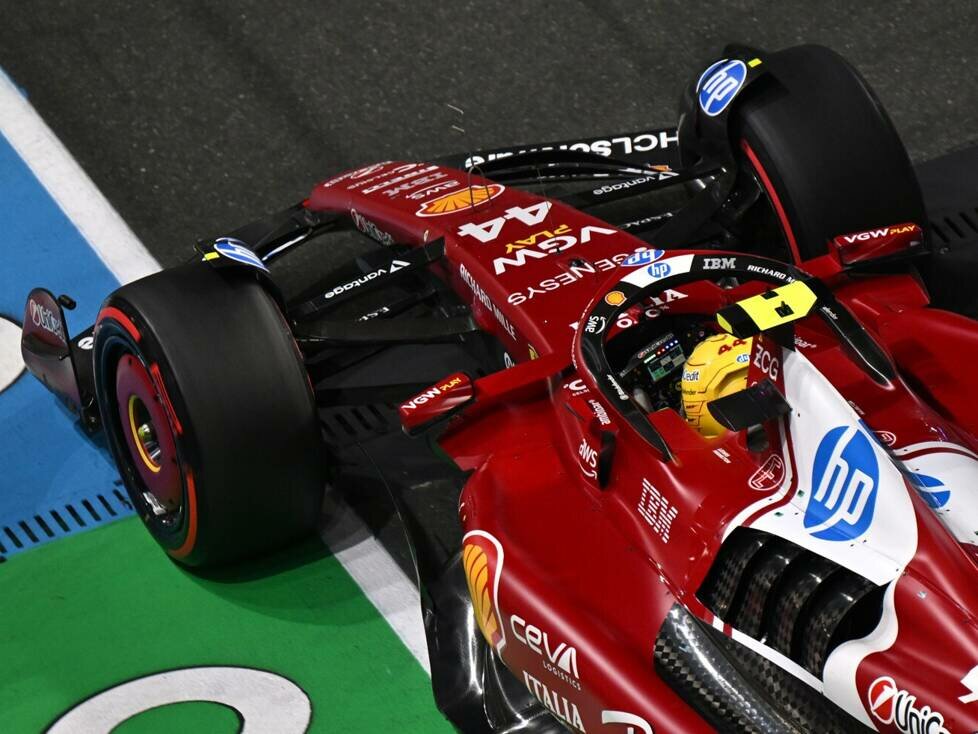
What Williams driver Carlos Sainz thinks about his Ferrari successor Lewis Hamilton and his adjustment to the new Formula 1 team
Seven-time Formula 1 world champion Lewis Hamilton is struggling after his move from Mercedes to Ferrari, but his Ferrari predecessor Carlos Sainz is “not at all” surprised. Sainz said this ahead of the 2025 Miami Grand Prix.
He says he had a similar experience at Williams: “There are no secrets in this sport, and when you’re competing against two teammates like we are – Alexander Albon and Charles Leclerc – who know the team inside out and are already getting the maximum out of the car, then the most you can do is be a little bit better or drive at the same level.”
In Sainz’s view, it is “impossible” for a rookie to be “two or three tenths faster” right off the bat. That’s why it’s perfectly clear that a driver will “need time” after switching teams, according to Sainz. The reason: “Your teammate knows a lot more than you do.”
This experience gap needs to be made up. “The faster you go through this process and get to this level, the better. But for some drivers it takes longer, for others it takes less time,” explains Sainz.
Hamilton, on the other hand, got off to a good start in his Ferrari career, winning his second race in red: the sprint at the Chinese Grand Prix. “But now he seems to be having a few more problems,” says Sainz. Hamilton himself sees it similarly and said after the Saudi Arabian Grand Prix that the rest of the season would be “painful” for him and Ferrari.
How long can the adjustment period last?
But how long does it actually take for a driver to fully master the switch? “That’s a difficult question,” says Sainz. “It depends on how natural the car feels to you. It depends on how good your relationship with the engineers is and how well you work together.”
“I’ve always said that to really get to know a car, you need at least six months to a year to experience everything with it.“
”That doesn’t mean you can’t perform this year. That’s a different issue. You can drive at 100 or 99 percent, and your 99 percent can still be pretty good. But to really get everything out of the car, I think you definitely need six months.”
Sainz does not want this to be taken as an excuse: ‘I want to perform like I did in Jeddah, but from the first race, even if I’m at 97 percent instead of 100 percent. But that takes time, and I will demand that of myself.’
A lot has changed in Formula 1 since 2022
But since the introduction of the new technical regulations for the 2022 season with ground effect cars, Formula 1 has become more complex and complicated, even for the drivers.
“You have to drive today’s cars in a very specific way to be fast,” says Sainz. ‘With the 2021 cars, you could get roughly the same lap time with two or three different driving styles because the car allowed you to push it to the limit in different ways.’
Ground effect race cars, on the other hand, require “you to approach a certain driving style,” according to Sainz. And: “If you don’t drive that way, you’ll never be fast. It just depends on how the car interacts with you, what it allows you to do in that particular way. You have to understand that.”
The role played by the Ferrari engine brake
When changing teams, there is also the technical orientation of the new racing team to consider. Hamilton himself has already pointed out the different engine brake settings compared to Mercedes.
“For me, that’s just one of 15 things you have to learn,” says Sainz. ‘Some teams tune the engine brake to support the car’s steering response. Others rely more on the differential. Still others prefer brake balance or work more with the car’s setup.’
As an outsider, it’s “impossible to imagine how you can get a car to achieve similar lap times in completely different ways,” says Sainz.
In search of the eureka moment
He himself is still in the discovery phase at Williams-Mercedes: “Of course, I try out high engine braking levels, then low ones again, I test different differential settings, I try out mechanical setups. I just try everything every weekend to see what the car likes and what it doesn’t.”
Some of it suits his driving style, some of it doesn’t. “But I enjoy this process,” says Sainz. “You inevitably make mistakes. But as long as you enjoy it and accept it, you know you’re going to get it wrong a few times. And when it clicks and works, it’s actually a eureka moment that feels really good.”