


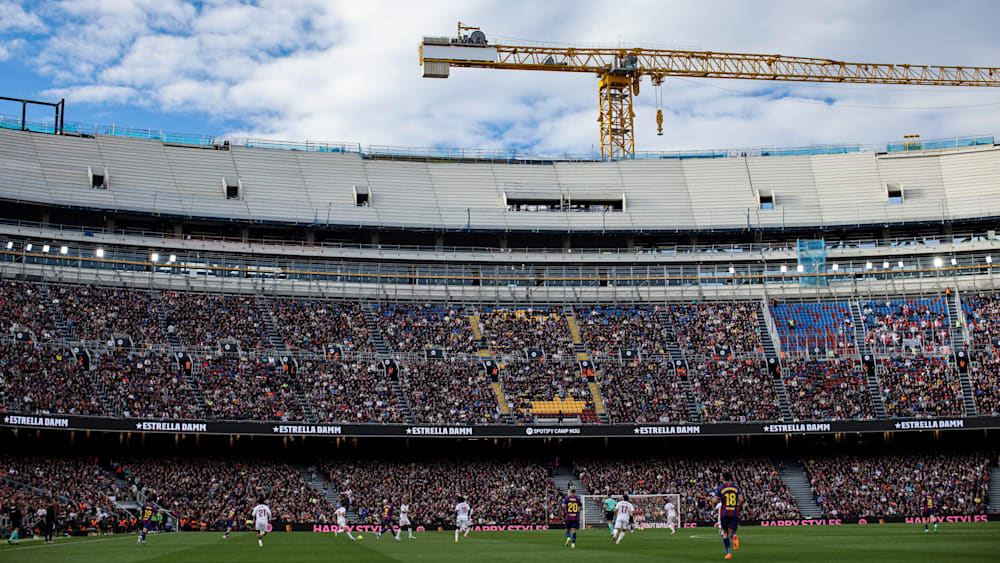
A halt to the stadium refurbishment has been averted, as FC Barcelona has taken out a new loan of 300 million euros. Treasurer Olivé, who is also vice-president, remains optimistic. Yet there is a threat that the club will once again have to move to the unpopular Olympic Stadium in 2027.
9 wins from a flying start: a solo record after the Clásico?
FC Barcelona are unstoppable on the pitch: a 5–2 win away at Betis Sevilla marks their ninth victory in nine La Liga matches, equalling the old record set by Real Madrid, who also recorded nine consecutive wins at the start of the 1968–69 season.
Interestingly: If Barca win the Clásico this coming Sunday against their arch-rivals, they will become the sole record-holders.
New loans for the stadium refurbishment
However, the refurbishment of the Camp Nou stadium was now facing a potential deadlock. The problem has been resolved for the time being with new loans. Two billion euros. As things stand. That is likely to be the minimum cost of FC Barcelona’s Camp Nou in the end, after the club’s most recent general meeting approved, by a large majority, a new loan of 300 million euros to prevent a partial halt to construction and potential future contractual disputes with the construction firm Limak.
Camp Nou currently has a capacity of 62,000 fans; in the course of the season, probably in the spring, this is set to rise to around 72,000 spectators, and ultimately to around 105,000, which is expected to be the case by the start of the 2028/29 season. In 2029, the Champions League final will then be held at Camp Nou.
According to treasurer and vice-president Ferran Olivé, additional costs had been incurred, particularly in relation to work on the second tier, as well as in the catering facilities, the museum and the digital facilities. Olivé explained at the General Assembly, which took place exclusively online: “There were delays, changes and improvements.”
A halt to construction would have set the club back in its already delayed schedule and cost millions every month; the new loan is intended to prevent this. It is to be repaid using future stadium revenue. Many club members found this too vague, though the criticism remained limited. In any case, there is no alternative to continuing the construction of Camp Nou.
Critical voices are to be silenced
The online format is also seen as a means for the club’s leadership to prevent critical voices from being heard. Which sounds plausible. Of the approximately 4,600 delegates, only around 600 voted, with 562 voting in favour of the new loan.
Moreover, the club members also approved two tranches of 105 million euros each, which were raised to finance day-to-day operations. One of these bonds, secured against future TV revenues, had already been placed on the capital market in July; the second issue is due to follow in November.
As is so often the case, Barça remains undaunted in its optimism about the future. Olivé: “Once the stadium is complete, sponsorship revenue will rise; we’ll sell more in the shops – it’s a virtuous circle.”
The target: triple the revenue
The club hopes that revenue from stadium operations could then rise from the current figure of around 150 million euros to approximately 425 to 450 million euros.
However, this is by no means guaranteed. This is because, in order to install the roof structure, Barça will probably have to move back to the Olympic Stadium for around half a year at the start of the 2027/28 season. Revenue there will initially fall again. It remains to be seen by how much.