


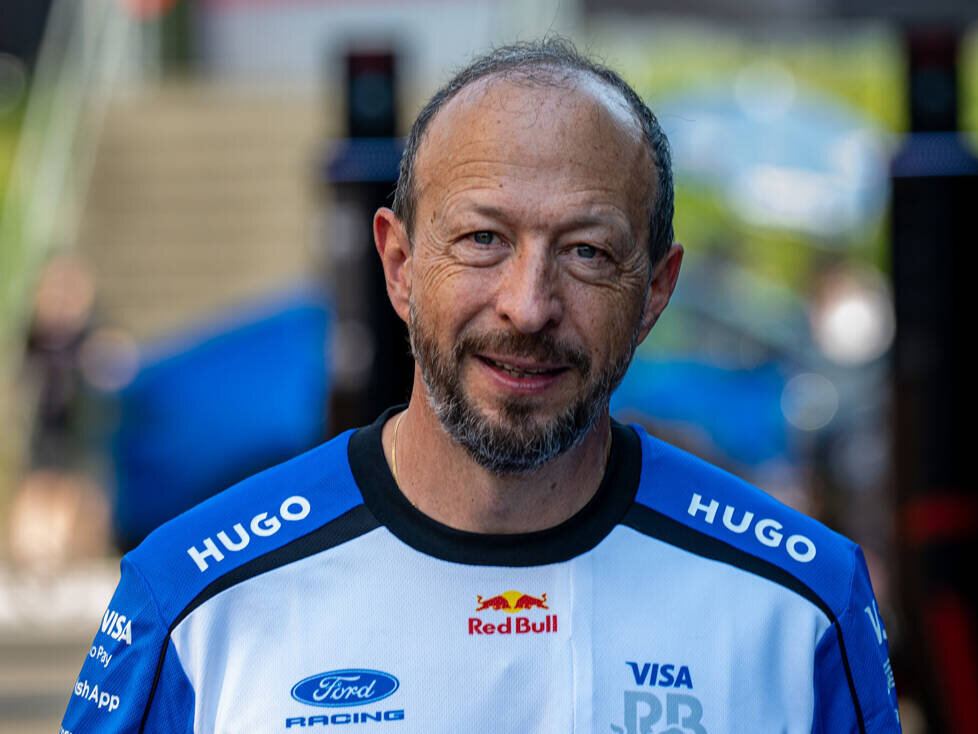
Following George Russell’s pole position, Peter Bayer criticizes Formula 1’s yellow flag regulations and calls for clearer guidelines to improve safety
George Russell’s pole position at the Austrian Grand Prix has reignited an old debate in Formula 1. Although a yellow flag was waved in the decisive final sector due to Max Verstappen’s crash, the Mercedes driver was allowed to keep his lap.
This was made possible by the current regulations, which merely require a reduction in speed without specifying exactly how much. Racing Bulls CEO Peter Bayer considers this to be problematic and advocates for a rule change.
The basis for this is Article B1.9.4 of the Sporting Regulations. It stipulates that when a single yellow flag is waved, drivers must reduce their speed and be prepared for a possible change in direction. However, it does not define exactly how much they must actually slow down.
Bayer recalls his time at the FIA
For Peter Bayer, this loophole comes as no surprise. The current CEO of Racing Bulls worked at the FIA for many years and still remembers well how the current wording came about. “That brings back memories of the discussions I had when I was still at the FIA,” Bayer explains to Sky.
In his view, Formula 1 has ultimately created a problem for itself with its desire for rules that are as precise as possible. “One phenomenon in Formula 1 is that teams and drivers always want everything defined very precisely.”
In the past, however, the meaning of a yellow flag was unambiguous. “A yellow flag clearly meant: danger on the track. With double yellow flags, you practically had to be able to stop at any time within the visible section of the track.”
The problem lies in the details
According to Bayer, today’s problems only arose when attempts were made to define the requirements more precisely. “That’s exactly what we discussed with the sporting directors back then.”
The teams wanted to know what a reduction in speed actually meant. “‘That needs to be defined,’ they said at the time.” Ultimately, it was decided that drivers must at least briefly ease off the gas when a single yellow flag is waved.
“People were then probably led to say: ‘With a single yellow, you have to ease off the gas.’ But no one specified how long you have to do that.” This has led to situations that, while compliant with the rules, are—in his view—hardly in the interest of safety.
Verstappen has already provided a historical example
In this context, Bayer recalls an incident involving Max Verstappen that sparked debate several years ago. “There’s a historical example involving Max Verstappen. I think it was in Jeddah. He actually lifted off for twelve thousandths of a second and then immediately accelerated again.”
This is precisely where Bayer sees the fundamental problem. “Under the current regulations, that’s allowed.” Therefore, he says, the race stewards cannot be blamed in this particular case. “The race stewards handled it correctly.” After all, they merely applied the existing rules.
“The wrong message for young drivers”
Nevertheless, Bayer considers the current interpretation problematic. “Personally, I believe this also sends the wrong signal to young drivers.” In his opinion, the significance of yellow flags is now too often underestimated, even in the junior series.
“Yellow flags are also ignored quite often in the junior categories.” Precisely because Formula 1 serves as a role model, he believes the issue needs to be reevaluated. “I actually think we should give this some thought.”
In doing so, Bayer is indirectly calling for a clearer definition of just how much drivers must actually slow down when a yellow flag is displayed.
Ralf Schumacher: “It’s about people’s health”
Sky expert Ralf Schumacher also sees an urgent need for action. For the former Formula 1 driver, safety takes precedence over all sporting considerations. “In my view, that’s how it has to be.” And the reason is obvious. “It’s about people’s health.”
Schumacher points out that even a slight reduction in speed is no guarantee of safety. “Two tenths is nothing. And the most important point is the role model function that Formula 1 plays for young drivers.”