


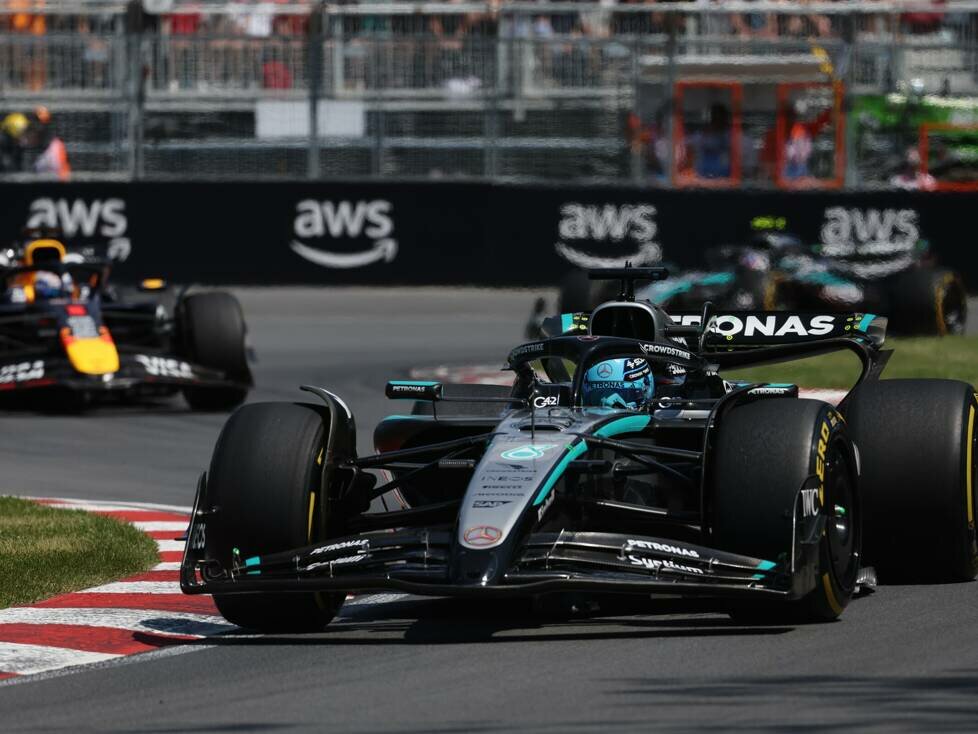
Red Bull’s protest against George Russell in Canada has highlighted a problem with the current rules that is particularly unsatisfactory for fans
Red Bull’s decision to contest the result of the Canadian Grand Prix has sparked widespread criticism. Mercedes team boss Toto Wolff described it as “petty” and “embarrassing,” and the long delay in confirming the race result was also met with incomprehension by fans and the media alike.
It took more than five and a half hours for George Russell’s victory to be officially confirmed by the FIA after the race stewards cleared him of any wrongdoing. By that time, Max Verstappen had already left Canadian soil – he didn’t even wait to see if he could be awarded the victory at the green table.
Red Bull’s protest focused on the fact that Russell had driven “unpredictably” behind the safety car and that his heavy braking should be considered “unsportsmanlike conduct.” Both arguments were rejected by the race stewards.
The real problem, however, was the enormous delay, and it is precisely this that raises questions about the protest rules for race results.
Wolff criticized the timing of the protest at the premiere of the F1 film in New York, telling Sky Sports: “Two hours passed before Red Bull lodged the protest – they have only themselves to blame for that. It’s so petty. They come up with some strange clauses. The FIA needs to look at this because it was so far-fetched that the protest was rejected.“
Unsurprisingly, Red Bull team boss Christian Horner defended the move, telling the same channel: ”Every team has the right to do that. You can put it to the race stewards, and that’s exactly what we did. I have absolutely no regrets.
Who is to blame?
Teams have the right to contest a result if they believe that sporting regulations have been breached or if there is new evidence that the race stewards have overlooked.
Horner admitted that the protest cost €2,000 and confessed that he was surprised that Russell’s driving was not automatically investigated.
It wasn’t Red Bull’s first protest of the season either. At the Miami Grand Prix in May, the team accused Russell of not slowing down enough under yellow flags – that was also rejected. According to Horner, Red Bull only wanted to clarify the interpretation of the rules.
However, protests like this raise fundamental questions about the protest rules. The €2,000 fee is not a deterrent. So anyone who wants to send a message or question the rules can easily do so – even if there are other, less time-consuming channels available.
If this fee were significantly increased and, for example, counted toward the budget cap, frivolous protests could be avoided.
A higher financial outlay would mean that only well-founded protests would be submitted and the process would be accelerated overall.
A question of resources
In Canada, the situation was also complicated by the large number of incidents to be investigated. The rule states that protests are dealt with in the order in which they are received. Red Bull’s protest, which was only submitted two hours after the finish, therefore ended up at the back of the queue.
Before Russell, the stewards had to review incidents involving Oliver Bearman, Lando Norris, and Esteban Ocon, followed by seven other alleged safety car violations.
The long wait frustrated everyone involved. Fans at the track left without clarity, and many viewers in Europe went to bed without knowing who had actually won the race. This was not a good look for a series that wants to increase its popularity in North America.
One possible solution would be for the Remote Operations Center in Geneva to review the less serious violations in parallel, relieving the race stewards at the track. This would speed up the decision-making process. Another option would be to increase the number of race stewards – the FIA is already working on recruiting more qualified personnel.
One thing is certain: the long delays in confirming race results must be addressed urgently. If this becomes the norm, it would be a bad sign for everyone involved.