


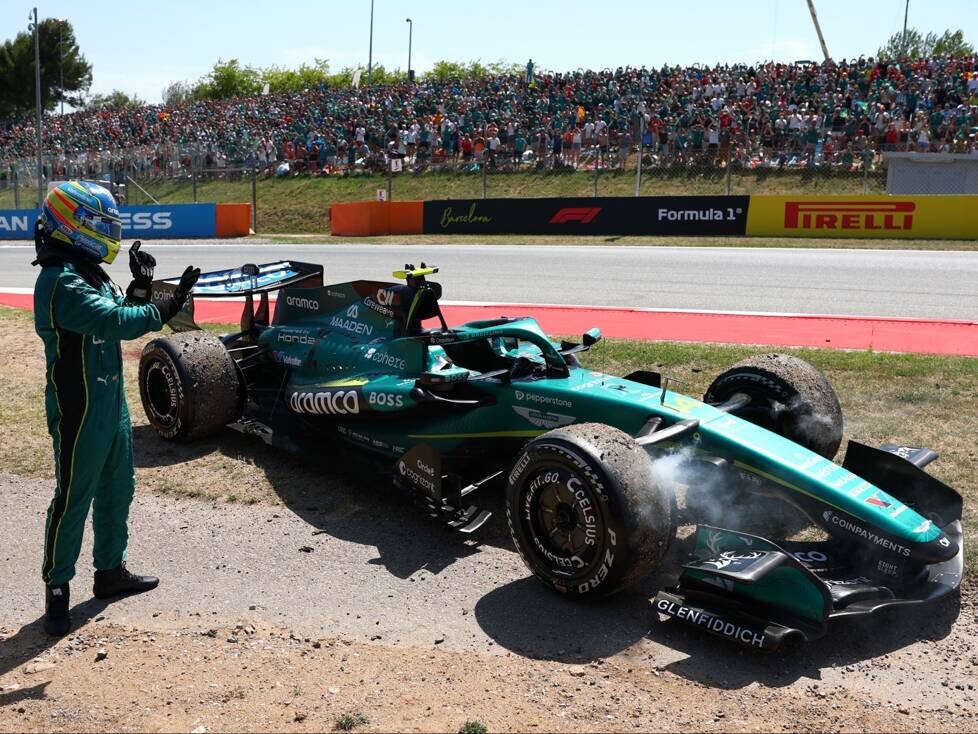
ADUO will give Honda opportunities to close the gap with other engine manufacturers—but its room to maneuver remains limited
Perhaps the least surprising aspect of the FIA’s controversial decision last week regarding Additional Development and Upgrade Opportunities (ADUO) was the confirmation that Honda’s Formula 1 engine lags behind the competition. That has been obvious since the start of the season.
ADUO—the ranking that no one in Formula 1 wants to top—is a prime example of unintended consequences. The FIA was prepared to include significantly more parameters in its performance evaluation, but teams and manufacturers advocated for a simple and streamlined solution. Now, at least one of them has ended up hurting itself.
While Red Bull is vociferously protesting the ranking—CEO Oliver Mintzlaff met with FIA President Mohammed Ben Sulayem in Paris last week, meaning the matter has already escalated to the executive level—Honda is working behind the scenes to make the most of the opportunity at hand.
In a similar vein, Honda’s chief engineer, Shintaro Orihara, responds to the question of whether the official FIA rankings align with his own expectations. “I think RBPT [Red Bull Powertrains] has done a great job, and I respect what they’ve done. “The figures we received from the FIA are quite fair for us.”
“I can’t disclose any details beyond what the FIA has published. But we have received certain figures,” says Orihara, explaining: “Now we’re focusing on further developing engine performance over the summer.”
“We’re working on improving combustion and reducing friction losses to boost power,” he says, emphasizing: “That will help us improve our performance.”
A distinctive feature of the ADUO system is that while the internal combustion engine forms the basis for performance evaluation, the approved development opportunities go beyond that.
The fact that Honda is focusing on combustion efficiency and friction losses shows where the greatest gains are expected—and not in the electric system, even though it is known that there are shortcomings there as well.
Manufacturers that trail the reference engine (in this case, Red Bull) by up to two percent are permitted to further develop a component of the power unit that would otherwise be frozen until 2028. Those trailing by more than four percent receive two upgrades.
The sliding scale also includes more test bench time and permission to exceed the budget limit. The additional leeway ranges in stages from four to six percent, then six to eight percent, and finally eight to ten percent.
For manufacturers trailing by more than ten percent, there are additional regulations, including the option, in extreme cases, to draw up to eight million U.S. dollars from future budget periods.
It’s not just the Honda engine that’s the problem
In the paddock, however, it is widely believed that Honda’s engine is about six to eight percent behind the benchmark. Furthermore, Aston Martin’s chassis and gearbox are also said to contribute to the lack of competitiveness.
Things sounded different at the start of the season, when Adrian Newey indirectly blamed Honda during a remarkable press conference ahead of the Australian Grand Prix.
In the months that followed, however, it became clear that numerous design decisions—including some that Newey himself had pushed through relatively late after joining the team—had contributed to the problems.
The extremely compact rear-end packaging Newey sought to improve aerodynamics required several compromises. One of these was a “double-deck” battery design, which proved to be susceptible to vibrations in the chassis.
Another was the unusual position of the electric motor—in front of the internal combustion engine rather than near the transmission. Although the motor was initially blamed for the vibration problems, Honda emphasized that these did not occur on the test bench.
As a result, an AMR26 chassis was sent to the research and development center in Sakura for further investigation. It is believed that the motor triggered a resonance in the chassis at a certain RPM.
That is why Aston Martin has not brought any updates to the track since the start of the season and is instead focusing on a B-spec version of the car, which is scheduled to be introduced this summer.
The decision to first resolve its own issues should help avoid an escalation with its engine partner—such as the one that occurred between McLaren and Honda in 2017. At that time, the split led to McLaren only fully recognizing the weaknesses of its own overall package once it switched to a different engine.
Car undriveable? Every lap a “game of chance” for Alonso
Since the Canadian Grand Prix, both Aston Martin drivers have consistently emphasized that the biggest problem is drivability, particularly due to a lack of synchronization between the power unit and the gearbox.
This leads to “random” downshifts and a handbrake effect that severely undermines confidence in the car. “We say the same thing every weekend,” explained Fernando Alonso after qualifying in Barcelona.
“It’s exhausting. We’re last, we know it, and we have no problem admitting it,” said the Spaniard. “We’re waiting for the second half of the season, and hopefully we can improve a bit with the new car.”
“Until then, we’re just trying to make the weekends as pleasant as possible, with as few problems as possible, without damaging the car, so we don’t jeopardize the budget cap,” he said, emphasizing: “It’s the same thing over and over again.”
“In some corners, it felt like pulling the handbrake—complete lockup on the rear axle. In others, I felt like I was only at half throttle when braking, and then you just keep going straight.”
“Right now, every lap is a gamble,” said the two-time world champion. “We have a very bad engine—the worst one. We have very poor power delivery. We have gearbox problems and aerodynamic problems.”
“We’re working on everything, and hopefully we can offer the fans something in the second half of the season,” he says. In elite sports, it’s all about controlling the things you can control. With the AMR26, however, certain compromises are inherent in the design—for example, with the battery and electric motor.
It’s difficult to assess from the outside just how much these factors contribute to the power delivery deficits. What is clear, however, is that these aspects cannot be changed in the short term. Therefore, it makes sense for Honda to focus on relatively accessible improvements such as combustion efficiency and friction losses.
However, caution is warranted: If progress is too great by the time of the next ADUO evaluation, fewer development concessions and less budgetary leeway may be available in the future.