


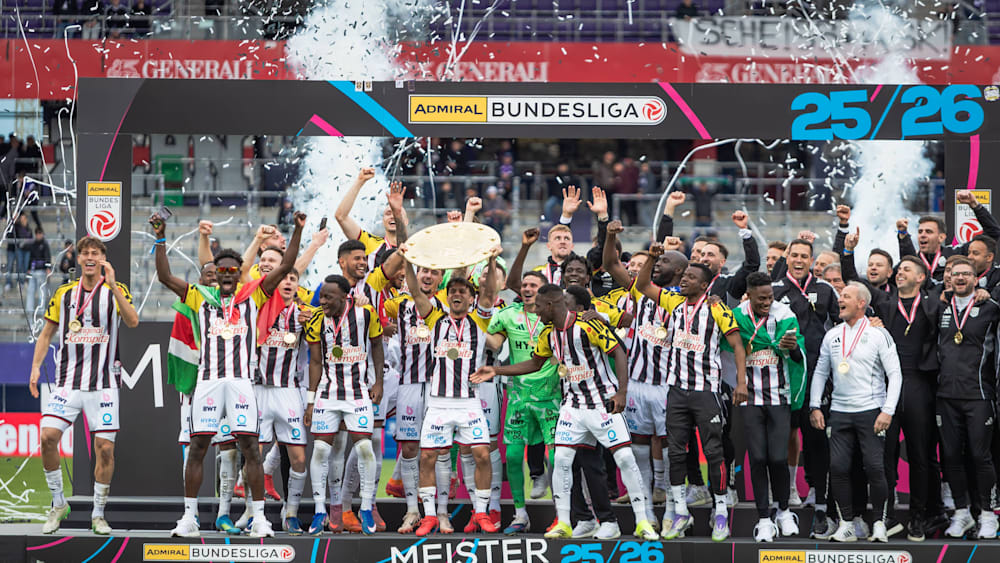
LASK has won the double for the second time in the club’s history. In 2012, the Black and Whites had been relegated to the country’s third-highest division.
After more than six eventful decades, marked by sporting and financial ups and downs, LASK has returned to the top of Austrian club soccer. Thanks to a decisive 3-0 away win against Wiener Austria, the Linz-based team has been crowned champions and double winners since Sunday. The cup victory was secured on May 1 with a 4-2 win over Altach in extra time. With this, LASK achieved a feat similar to that of 1965.
Back then, too, the Upper Austrians were crowned league and cup champions, becoming the first Austrian champions not based in Vienna. However, LASK did not remain in the top echelons for long; in 1978, they even had to cope with relegation. At least they managed to return to the top flight immediately. In the 1980s, there were no titles, but there was a European Cup highlight: in 1985, Inter Milan—packed with world-class players—was defeated 1-0 in the UEFA Cup at the Linz Stadium. In the return leg, they suffered a 0-4 loss.
Low point: License denial in 2012
These highlights could not prevent LASK’s gradual decline. In 1989, the club was relegated to the second division; it took five years to climb back up a level—before having to file for bankruptcy in 1995 due to severe financial turmoil and narrowly averting liquidation. Things also got heated in 1997 during the controversial merger with city rival FC Linz and in 1998 due to the collapse of Riegerbank, owned by club president Wolfgang Rieger.
Financial problems were a constant companion during this period, as well as after the takeover by Peter Michael Reichel in 2000, and played a significant role in the team’s relegation in 2001. It took six years to return to the top flight, but by 2011 the team had already fallen back to the second-highest league. The low point was reached in the spring of 2012, when LASK failed to obtain a license for the following season and was therefore forced to compete in the Regionalliga.
The greater the successes, the smaller the protests
After that, things slowly but steadily improved, thanks in part to the arrival of the “Friends of LASK,” who ended Reichel’s era in 2013. Oliver Glasner was hired as coach, leading the Linz-based club to the Bundesliga in 2017 and straight to a fourth-place finish. Under Glasner’s successor, Valerien Ismael, LASK stood in first place at the end of the 2019/20 regular season. But then came COVID-19, evidence of violations of hygiene rules during training, a resulting four-point deduction, and ultimately a fourth-place finish.
The pandemic also cost the Linz-based club a sold-out home match against Manchester United; the first leg of the Europa League round of 16 against the Red Devils took place in front of empty stands—much to the annoyance of Siegmund Gruber, who was then, as he is now, the driving force behind LASK.
The club president sets budgets that are among the highest in the country. Under Gruber’s leadership, the Raiffeisen Arena was also built—the new home stadium, which opened in 2023 and regularly hosts international matches. Nevertheless, Gruber’s actions are viewed quite critically by large segments of the organized fan base, such as the sponsor-driven decision to change the color of the LASK jersey to pink. Early in this season, a vocal boycott was announced. But the greater the successes became later on, the smaller the fan protests grew.