


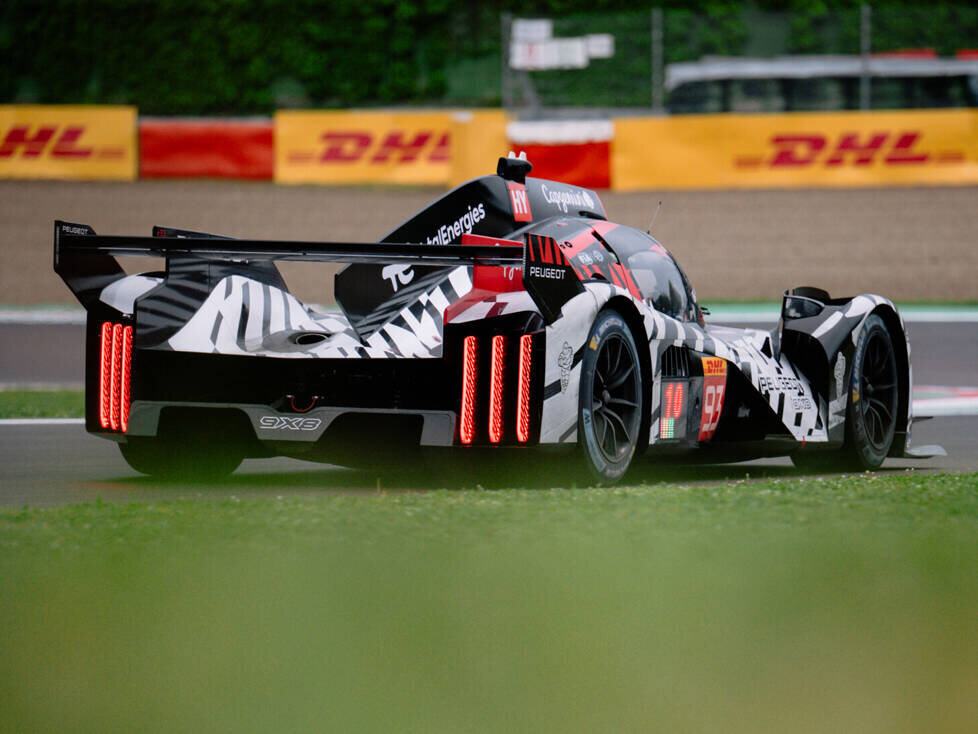
Peugeot is planning the homologation of a new hypercar based on the 9X8, which is to be used from 2027 – but why it will not be a completely new development
Peugeot announced at the season opener of the World Endurance Championship (WEC) in Imola that it now intends to homologate a new hypercar as the successor to the current 9X8. At the end of 2025, the French company had emphasized that it wanted to focus exclusively on further developments.
However, while Alpine is pulling the plug at the end of the year, Peugeot has extended its WEC commitment for another three years – and therefore wants to develop a vehicle that builds on the strengths of the current LMH with the clear aim of competing at the top in the long term.
“The rule change will come in 2030, but our priority was to have planning security for the next three years – and we have been given that,” Peugeot CEO Alain Favey told Motorsport.com at a meeting with Italian journalists,
“We want to stay until the end of 2029, and to be competitive we need to work on the evolution of the current car,” the Frenchman emphasized. “The plan is this: there will be a new homologation that will allow us to be more competitive.”
9X8 successor will “not be a completely new car”
“We’re starting with the current car, which we know well, so it won’t be a completely new vehicle. However, we have exhausted all the Joker Evo options for the 9X8, so we have to homologate a car from scratch.”
In other words, Peugeot will not be developing a completely new hypercar, but will continue to use components that have proven themselves on the current 9X8. A test program will therefore be set up in the coming months to ensure the introduction of the “new” car for the 2027 season.
“We are working on it and I am very confident that we can achieve a good result,” said Favey. “I don’t yet know when we will go out on the track for testing, but one thing is clear: in order to be ready in time for 2027, we need to schedule testing in the coming months.”
In parallel, discussions are continuing with the FIA and the Automobile Club de l’Ouest (ACO). The focus is on a revision of the regulations, which should enable a uniform platform or at least technical convergence between LMDh and LMH.
Guarantee for the future was a condition
Peugeot CEO Favey also emphasized that the guarantee of being able to compete with the new homologation of the LMH cars over the next three years was precisely the decisive factor in extending the commitment and reigniting the ambitions.
“It was crucial for us to have a three-year plan based on stable rules before the regulations change,” said the Frenchman. “I can say that it is worth investing. What happens after that, we will evaluate from a strategic point of view.“
”Our focus is on 2027, 2028 and 2029. The future will also depend on the performance of the car in these years. Our goal is to be consistently in the top 4. If we don’t succeed, we will examine whether and how we can continue.”
Peugeot wants to “give the WEC chapter a happy ending”
“It’s important for a brand to have a history – and Peugeot doesn’t want to keep entering and exiting different championships,” the Peugeot boss clarified. “This year marks the 100th anniversary of our first participation in Le Mans, a significant milestone that gives the brand additional credibility.”
“We are currently writing a story with positive and negative chapters. We want to give it a happy ending, which can be achieved through strong performances throughout the championship and at Le Mans. We will assess the situation at the end of 2029.”
“For Peugeot, the 24 Hours of Le Mans is undoubtedly more important than the World Championship, in which we are nevertheless fully committed,” emphasized Favey. “But in France, this race is a huge celebration and therefore has a very special significance.”